|
UKIM Informational Portal on Rankings Ranking | RANKING
For several decades, global ranking services have evaluated universities worldwide, initially established in countries with advanced higher education systems. These rankings are based on classification criteria and quality indicators, using metrics that assess academic characteristics. Originally exclusive to Anglo-Saxon countries for evaluating business schools, these rankings have expanded globally to include all types of higher education institutions. The purpose is to transparently present institutional performance across various areas, including research, education, social impact, employability, sustainability, excellence, and visibility.
This informational portal by Ss. Cyril and Methodius University in Skopje (UKIM) highlights the most influential international university ranking systems, providing concise explanations of their classification criteria and evaluation indicators. |

| The ARWU ranking (Academic Ranking of World Universities The Academic Ranking of World Universities, more commonly known as the Shanghai Ranking, is one of the most well-known university rankings worldwide, compiled by a group of bibliometrics specialists from Shanghai Jiao Tong University (China). This list includes the largest and most influential higher education institutions in the world and covers more than 25,000 universities.
The focus of this system is on research activity, thereby enabling a uniform comparison between universities. This focus is based on the premise that good research results lead to good results in the other dimensions.
The positioning system is individualised for the top 100 universities, while from position 101 onwards positioning is grouped according to the categories defined by the ranking. Since 2003, ARWU has annually presented the world's top 2,000 ranked universities.
|
Methodology and indicators
The methodology for ranking universities is based on an algorithm that takes into account the following ARWU indicators:
|
Other classifications
In addition to the main ranking, ARWU publishes:
|
Useful information about the ARWU university ranking:
- More information
- Publication frequency – annually, in August

| CWUR Centre for World University Ranking The Center for World University Rankings is a consultancy organisation that provides policy advice and strategic insights to governments and universities to improve educational and research outcomes. Since 2016, CWUR has been based in the United Arab Emirates.
Since 2012, CWUR has been publishing an academic world university ranking that assesses the quality of education, student employment, research output and citations, without relying on surveys or data provided by the universities. Initially, the CWUR ranking presented the top 1,000 of over 18,000 universities analysed worldwide. Since 2019, the published ranking results have been expanded to include the top 2,000 universities. |
Methodology and indicators
| CWUR uses seven indicators for ranking the best 2,000 universities in the world:
|
Useful information about the CWUR ranking
- More information
- Latest CWUR ranking results
- Publication frequency – annually, in June

| Quality Street World University Rankings It is an annual ranking of more than 1,000 universities worldwide, intended to serve simultaneously as a sectoral and regional classification, using six metrics to analyse university performance. This university ranking system is particularly supported and prestigious among European universities. Since 2015, standardisation of research areas and a more transparent methodology have been introduced, with the aim of ensuring objectivity in the ranking of universities of different sizes and with varying coverage of research fields.
In addition to the QS World University Rankings, this service also publishes and Specific rankings, according to the criteria introduced:
In addition to the aforementioned rankings, the QS World University Rankings service publishes a system for evaluating the performance of universities in various fields, called QS Stars University Ratings, whereby instead of comparing institutions with one another, they are assessed on their performance against the established standard. This system for evaluating university performance functions as a review of the universities' strengths and weaknesses, through an analysis of the data provided across a dozen indicators.The audit awards stars both by category and on a global level, without imposing a limit on the number of universities that can achieve the highest score or a relative ranking among them. |
Methodology and indicators for Quality Street World University Rankings
This system introduced a new the methodology for the 2023 ranking, by including new indicators related to sustainability and involvement in international research networks. The QS ranking service's metrics are based on the following indicators with the specified weighting factors:
|
Useful information about the QS ranking
- More information
- Publication frequency – annually, in June

| The ranking of the world's universities by Times Higher Education (THE), is the annual publication of the Times magazine's university rankings.
At present, several rankings are being published: On a global level:
For teaching:
At regional level:
By fields of knowledge:
|
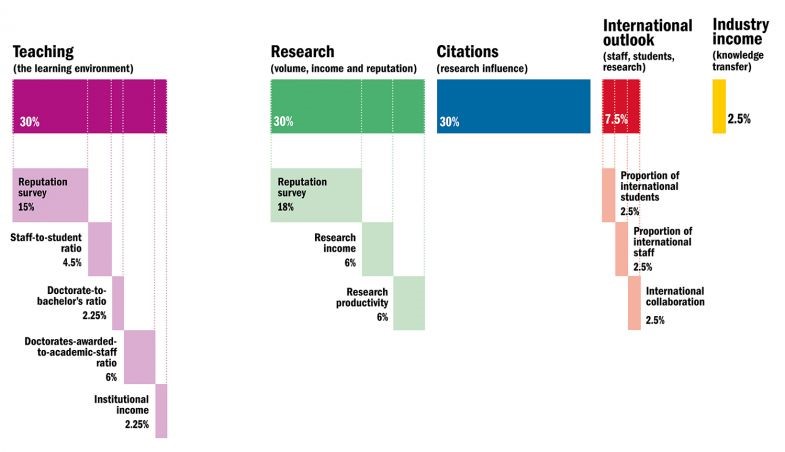
Methodology and indicators of the Times Higher Education
This university ranking service uses an academic classification with an objective methodology, but not a fully bibliometric one, based on the following indicators with the specified weighting factors:
|
Useful information about THE ranking
- More information
- Publication frequency – annually, in May

| SCImago Institutions Rankings (SCImagoIR) An international ranking of research institutions worldwide, conducted by SCImago LAB from Spain. |
Methodology and indicators of SCImagoIR
| This service made changes to the methodology at the beginning of 2023 and applied it to the results of previous years as well, which caused a certain disruption to the continuity of the layering of institutional rankings.
For this ranking service, the indicators They are divided into three groups intended to reflect the scientific, economic and social characteristics of the institutions. SCImagoIR provides global statistical data on the institutions' scientific publications and other outputs, thereby enabling comparisons to be made between institutions of different sizes. The methodology is based on the following three global indicators, which represent groups of sub-indicators (each assigned a different weight), with the final values normalised on a scale from 0 to 100.
|
Useful information about the SCImagoIR ranking
- More information
- Publication frequency – annually, in April

| Webometrics is a service for ranking universities worldwide, developed by the Cybermetrics Laboratory of the Spanish National Research Council (CSIC), which acts as a scientific and technological observatory available on the Internet. The classification is based on an analysis of data for more than 27,000 universities and over 5,000 research centres, and the results show the top 4,000 best-ranked institutions. |
Methodology and indicators of WEBOMETRICS
| The bibliometric methodology It takes into account the volume of content published on the web, as well as the visibility and impact of that content based on external links pointing to their websites. This methodology assesses the importance of the institution within the global social network of university sites.
The methodology has evolved significantly over the past decade, so that the results from the different editions are not directly comparable. The methodology is based on the following indicators with appropriate weighting factors:
|
Useful information about the SCImagoIR ranking
- More information
- Publication frequency – twice a year, in February and July

 Blvd. "Goce Delchev" no. 9, 1000 Skopje, Republic of North Macedonia
 ukim@ukim.edu.mk
 3293-293