Can donating blood harm us?
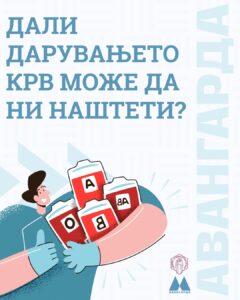 Not all heroes wear capes; some wear jeans and a T-shirt and donate blood.
Written by: Borche Isakoski
Quite inspiring, isn't it? It's one of the slogans most commonly used by various organisations and centres for the promotion of blood donation. Simple, concise and clear, yet it manages to capture the importance of this humanitarian act. Therefore, I would venture to suggest that almost anyone who came across this, or any other similar slogan, would at least pause for thought, feel motivated, and decide to take part in the next blood donation drive when the opportunity arose.
However, the statistics show that the real situation is different. So, let's see what the data tells us.
According to the paper 'Development of Transfusion Medicine in the Republic of North Macedonia', published in 2022 by the Institute for Transfusion Medicine of the Republic of North Macedonia, the annual blood donation rate in our country is 2.7 per cent.
Although, according to the World Health Organization's criteria, this percentage is sufficient to meet blood requirements in hospitals nationwide, the research points to several important conclusions:
The number of voluntary donations is significantly higher than the number of family donations. In 2019, as many as 99.7 per cent of donations were voluntary. This figure is particularly significant because voluntary blood donation is considered the safest and most reliable way to ensure sufficient blood supplies.
Furthermore, the percentage of women who donate blood remains significantly lower than that of male donors. In 2019, women accounted for 20.5 per cent and men for 79.5 per cent of the total number of donations. However, it is encouraging that, according to recent research by the Faculty of Medical Sciences at UGJ, this gap is gradually narrowing among young donors in secondary schools.
Of particular concern is the low percentage of young blood donors. In 2019, they made up only 16.2 per cent of the total number of donors, with students contributing just 5.8 per cent. According to the latest research by the Faculty of Medical Sciences at the University of Tetovo, these figures have decreased further since the pandemic. This means that the system relies heavily on older and employed donors, who may be prevented from donating in the future due to their age or health condition.
Also, the number of people donating blood for the first time represents a relatively small proportion of the total number of donors. This indicates that the blood donation system relies heavily on the regularity and commitment of the same individuals.
I won't go into all the possible reasons why some people don't donate blood. However, one can assume that a certain number of citizens are afraid of the procedure itself and doubt that donating is entirely safe.
According to the Red Cross of the Republic of North Macedonia's Handbook for Young Motivators in Blood Donation, such fears are most often based on insufficient information and widespread prejudices.
First and foremost, it is important to know that before every blood donation the individual has a consultation with a doctor and basic health checks to determine whether they are in good health. This reduces the risk of any complications to a minimum.
Furthermore, the amount of blood donated amounts to about 10 per cent of the body's total blood volume. The body quickly compensates for this loss, and within around 48 hours the normal fluid balance is restored.
It is no less important that the equipment used during donation is sterile and single-use. Therefore, there is no possibility of the donor contracting a blood-borne disease.
In other words, you will not be left without blood, you will not fall ill from the donation itself, and you will not suffer any serious consequences if you follow the medical staff's recommendations.
On the other hand, as well as the personal satisfaction of helping someone who needs it most, donating blood also brings certain benefits. According to the Labour Relations Act, every blood donor is entitled to two consecutive days off work following a donation. In practice, this right is often honoured for pupils and students when it comes to their academic obligations.
Additionally, individuals who have donated blood more than ten times are entitled to an exemption from co-payment for certain health services. The Red Cross also awards certificates of appreciation and recognition as a symbolic acknowledgement of the humaneness and solidarity of blood donors.
From all of the above, it can be concluded that blood donation not only does us no harm, but is an act that benefits both the donors and the people who need the blood. Therefore, the next time you hear about a blood donation drive in your area, remember that one day it might be you, or a loved one, who needs blood made available thanks to the humanity of a stranger.
Don't wait for that day to come. If you meet the eligibility criteria for blood donation, join the next blood donation drive. With one simple gesture, you can help save someone's life.
The article is published by "Avangarda", the student newsletter of the University Communication Centre at the University "St. Cyril and Methodius" in Skopje – a virtual space where student ideas, challenges and successes find a voice, visibility and the opportunity to inspire positive change in the academic community.
References:
Velkova E, Makarovska-Bojadzieva T, Dejanova-Ilijevska V, Petkovic E, Ristovska E, Drakulevska S, Mitevska L. Development of Transfusion Medicine in the Republic of North Macedonia. Glob J Transfus Med 2022;7:71-6.
Petreski, S., & Mickoski, I. (2024). MOTIVATION OF WOMEN TO DONATE BLOOD. KNOWLEDGE – International Journal, 66(4), 503–509. Retrieved from https://ojs.ikm.mk/index.php/kij/article/view/7062
https://eprints.unite.edu.mk/957/1/Acta%20Medica%20Balkanica%20FINAL%20FINAL-70-79.pdf
https://api.ckrm.org.mk/wp-content/uploads/2016/07/Motivacija_na_mladi_krvodariteli1_web.pdf

 Blvd. "Goce Delchev" no. 9, 1000 Skopje, Republic of North Macedonia
 ukim@ukim.edu.mk
 3293-293