A look at university rankings

Regarding the ranking of universities in global rankings, it is important to note that each ranking has specific rules for its methodology. The rankings are based on various methodologies, developed and applied by different services for compiling university rankings, with specific indicators and metrics defined for their monitoring.
For the majority of services that compile global university rankings, the dominant indicators for the ranking are related to research and excellence. For the measurability of the indicators related to research, data indexed in the Web of Science (WoS) reference database from Clarivate Analytics and/or in the SCOPUS reference database from Elsevier are most commonly used.
In the context of one of the dominant indicators in ranking, namely scientific research, the University "St. Cyril and Methodius" in Skopje has prepared a self-evaluation of the academic staff's research output, through Analysis the coverage of UKIМ's scientific publications in the SCOPUS indexing database, which is used as a reference database by some university ranking services, including Webometrics.
In addition to the results of scientific research, various rankings evaluate many other indicators that are currently unattainable for UCM, such as the number of Nobel Prize laureates or recipients of the Field Medal in scientific fields for which the Nobel Prize is not awarded (the Shanghai Ranking). The QS list (QS World University Ranking) is becoming increasingly relevant in the European higher education and research space. For an institution to be ranked on this list, the primary criterion is a minimum of 1,000 scientific publications indexed in the SCOPUS database per year, over a specified period. From The analysis, It is clear that the requirement of 1,000 publications per year is the reason.
which UKIМ is not on the main QS list, but appears on the QS Emerging Europe and Central Asia list.
Analyses have determined that one of the main problems is the incorrect use of affiliation with UКИМ. Publications that are not indexed to UKiM are still being published, despite the fact that, in the past, UKiM's management implemented a procedure for the mandatory use of UKiM's statutory name (Ss. Cyril and Methodius University in Skopje) in all types of publications. It is expected that with the correct application of the affiliation, UGM's ranking status will be significantly improved, but this will require a longer period of time.
Among other things, in university rankings, indicators are used that also evaluate the University's reputation in terms of the employability of its graduates, and this is done through the number of graduates employed by top companies of global scale, none of which are from our country and a large number of which have no representation here, which indicates limitations in this type of indicator as well. Furthermore, among the ranking indicators is the number of employed academic staff from
strangeness, for which there are legal restrictions in our environment. Additionally, there are many other indicators that do not correspond to the reality in the country's scientific research environment, related to regulation, funding, the uneven development of research across different fields, and the limited opportunities for recruiting young academic staff.
It should be noted that in the university ranking section, teaching also plays a significant role, with the most commonly applied indicators relating to the following aspects: study programmes taught in English, joint degrees and double degrees with renowned universities in Europe and worldwide, international students, international professors, study programmes that facilitate mobility and networking.
Over the past year, UKI M initiated activities to analyse the methodologies used by the various world university ranking lists. This activity resulted in the adoption of measures to improve UKI M's visibility and ranking by the University's bodies. Further analyses, which are continuously being conducted, indicate the need to increase the number of publications indexed in WoS and/or SCOPUS, as one of the most stable indicators, which carries a high weighting factor in prestigious rankings.
The public pays particular attention to the Webometrics university ranking and often inappropriately bestows upon it the epithet of the "most prestigious" list. This ranking is comprehensive and ranks a large number of institutions, making it suitable for comparative results in our scientific research sphere.
On this list, UKI is currently ranked 1596th, and this ranking has been stable over the last four years. The highest ranking was reached in July 2021 (1493rd place), and just six months before that, UKI was ranked 1611th (graph 1). Mathematically, the graph suggests a linear function with a continuous upward trend. Both rankings (1493rd and 1611th) are within the variations characteristic of such lists, which are due to changes in the Webometrics methodology and not to six-monthly fluctuations in the quality of the universities.
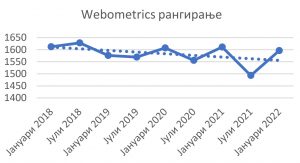
Graph 1. Ranking of UKI M on the Webometrics service for the period January 2018 – January 2022
The Webometrics ranking list of universities worldwide is compiled and published twice a year and, above all, is based on:
evaluation of internet content, internet traffic and open access to data, which as an indicator carries a weighting of up to 50 %;
evaluation of research and excellence, through two indicators, which together carry the remaining 50 % weighting, namely, the indicator for the analysis of citation counts for the institution's top 210 Google Scholar profiles, and the indicator for the analysis of the number of publications in journals ranked in the top 10% by scientific discipline, according to the SCIMAGO university ranking of SCOPUS.
The above-mentioned methodology has been applied since the beginning of this year. Previously, in addition to the three indicators listed, the presence indicator was also ranked. This indicator referred to sharing information in the online space that contributes to public knowledge and is no longer used.
The above indicates that the Webometrics service ranking methodology has undergone changes and that it no longer includes the former four indicators:
presence, openness, influence and excellence, the presence indicator has been abolished and the other three indicators are applied. This leads to a new redistribution of the indicators' weightings, i.e., a renormalisation of the methodology, which makes the results incomparable. For the aforementioned reasons, the Webometrics service highlights that due to the frequent changes in methodology, the results are not historically comparable.
The activities undertaken at UGJK to increase the visibility of academic staff through Google Scholar profiles may be influencing the greater variation observed in one of the last three rankings. The benefits of these activities are the realisation that every member of the academic community must engage in the activities, correctly apply their affiliation, feel part of UKiM, regularly carry out a self-evaluation, and report on their activities.
The academic community, in its pursuit of excellence, requires support from the institutions of the system, which must provide the conditions for quality, continuous scientific research and creativity. This is a fundamental prerequisite for improving the university's position in the rankings and the state of scientific research in the country. In The analysis An analysis from SciVal is presented, which highlights the significance of UКИМ in scientific research.
activities, referred to our country.
The discussion on rankings should encourage the proactivity and synergistic action of all stakeholders in the country's higher education and research space. The achievements of faculties and universities are the sum of the achievements of each individual member of the academic community. The results achieved in academic work are public, transparent, measurable and comparable. WoS and SCOPUS do not index social media posts, but only scientific publications that present data from serious research, conducted using the most up-to-date scientific research methods, which undergo a process of anonymous peer review that confirms the quality of the research and the results obtained.
Finally, it must be accepted that UKiM is all of us; UKiM is every individual, every single member of the academic community, regardless of whether they are a current or former student, academic, non-academic, or support staff member. We are all UKiM; its successes, as well as any potential failures, are the result of the activities of all of us. Fortunately, the results achieved in academic work are public, transparent, measurable and comparable.
In the coming weeks, we will undertake several public activities aimed at clarifying the methodologies for university rankings. One of these will be in collaboration with the Centre for Advanced Interdisciplinary Research (CeNIS) at UKI M and the S(c)iesta community of scientists of Macedonian origin. The event will be open to the public and will be a good opportunity to discuss the place of UGJK in global scientific trends.
Further information, in the context of this review, is available in the document: Analysis of the results of the scientific research work of UGJK through its coverage in SCOPUS: mapping the situation for the period 1991–2021, as a long-term average and separately for 2021..
Ss. Cyril and Methodius University in Skopje


 Blvd. "Goce Delchev" no. 9, 1000 Skopje, Republic of North Macedonia
 ukim@ukim.edu.mk
 3293-293